Certosa di San Martino

Covers Naples' museums, churches, castles, underground sites and walks, with tickets and hours checked against the official pages on the date shown.
UpdatedThis page carries dated prices or seasonal dates checked on the date above, and that window has now passed. Re-check the sources at the foot of the page before you book anything.
The Certosa di San Martino is the former Carthusian monastery just below Castel Sant'Elmo on the Vomero, now a state museum. It is open every day except Tuesday, 8:30 a.m. to 6:30 p.m., with last entry at 5:30 p.m. A full ticket costs €6; visitors aged 18 to 25 pay €2, under-18s enter free, and the first Sunday of the month is free for all. Tickets are sold at the entrance on Largo San Martino and online through the Ministry of Culture's Musei Italiani platform.
Two timing details from the Ministry's current listing. The church, cloisters and terrace open at 8:30 a.m., but the museum sections, including the presepe rooms, the naval section, the Prior's quarters and the 19th-century galleries, open at 9:30 a.m. The gardens close an hour before everything else. And the Gothic undergrounds are excluded from the route until further notice.
At a glance
- Admission
- €6 full; €2 for ages 18 to 25; free under 18. Free for everyone on the first Sunday of the month, as at all state museums.
- Hours
- Every day except Tuesday, 8:30 a.m. to 6:30 p.m., last entry 5:30 p.m. Museum sections open from 9:30 a.m.; the gardens close an hour early.
- Closed areas
- The Gothic undergrounds (Sotterranei Gotici) are excluded from the visit until further notice.
- Getting there
- Montesanto or Chiaia funicular to Morghen, then about 720 m (0.45 miles), 10 minutes. Castel Sant'Elmo is 200 m uphill.
- Time needed
- Two hours for the church, cloister, presepe section and terrace. Two and a half with the new 19th-century rooms.
- Groups
- Up to 25 people, no booking needed. No animals except guide dogs.
In this guide
The church: Neapolitan baroque at full volume
Charles, Duke of Calabria, son of Robert of Anjou, founded the charterhouse in 1325, and it was consecrated in 1368. What you see inside is later. From 1623 to 1656 the architect and sculptor Cosimo Fanzago gave the church its baroque dress: the facade, the inlaid marble of the nave and chapels, and much of the decoration beyond. He left after a bitter dispute with the monks in 1656, and others finished his work.
Look up first. The vault frescoes of the Ascension are by Giovanni Lanfranco, painted between 1636 and 1639. By the main door hang Moses and Elijah by Jusepe de Ribera, and above the door a Pietà by Massimo Stanzione of 1638. The single nave has eight side chapels, and beyond the altar a sequence of sacristy, choir, chapter room and further chapels continues the display.
Before the church you cross the Cortile Monumentale, and from the church you pass into the smaller Chiostro dei Procuratori and the refectory. All of these, with the great cloister and the terrace, open at 8:30 a.m., an hour before the museum rooms, so an early arrival can see the architecture first and then move on to the collections when they open.
The great cloister and the belvedere
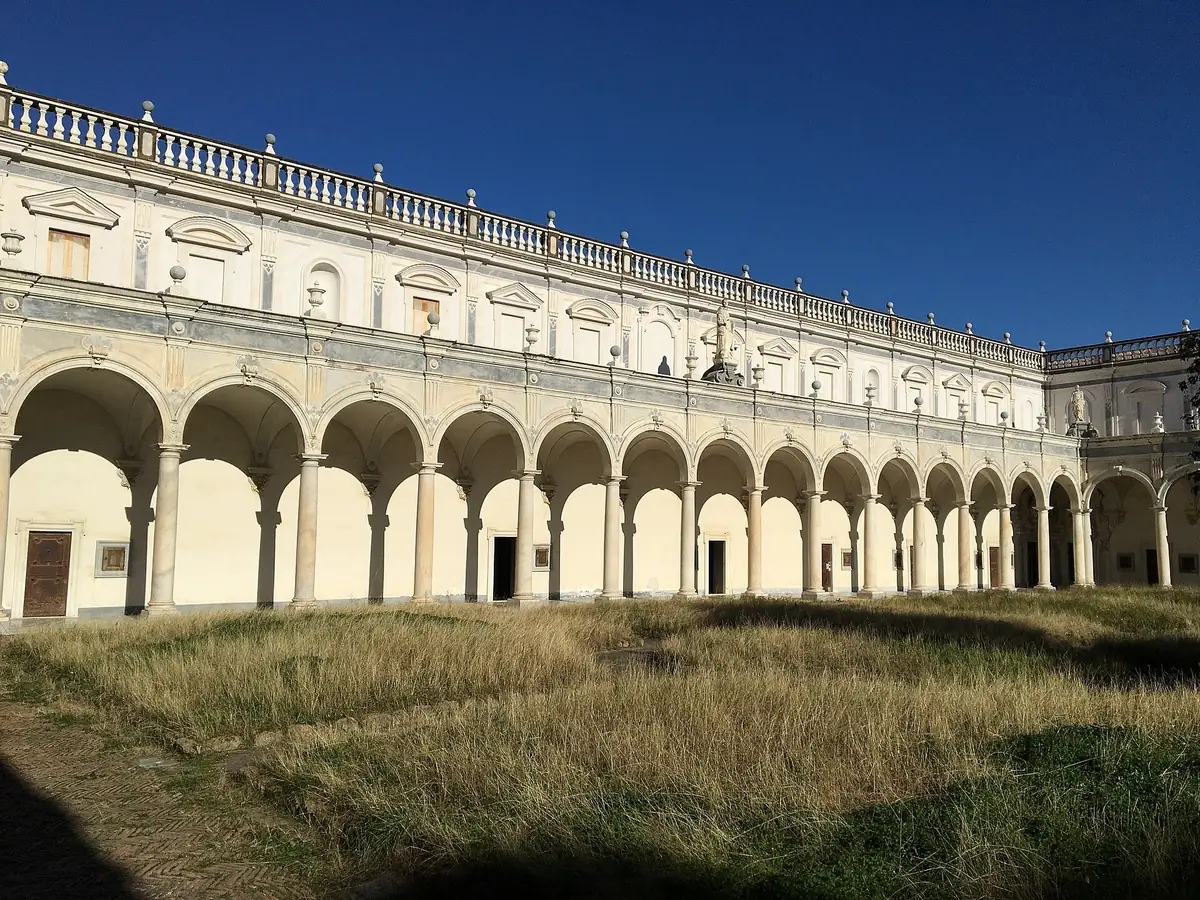
The Chiostro Grande was enlarged from 1581 by the Tuscan architect Giovanni Antonio Dosio, with a garden and wellhead at the center over a cistern, and completed by Fanzago. In one corner is the monks' monumental cemetery, which Fanzago also worked on. Along the arcades you can still see the doors of the monks' cells and the hatches through which their food was passed.
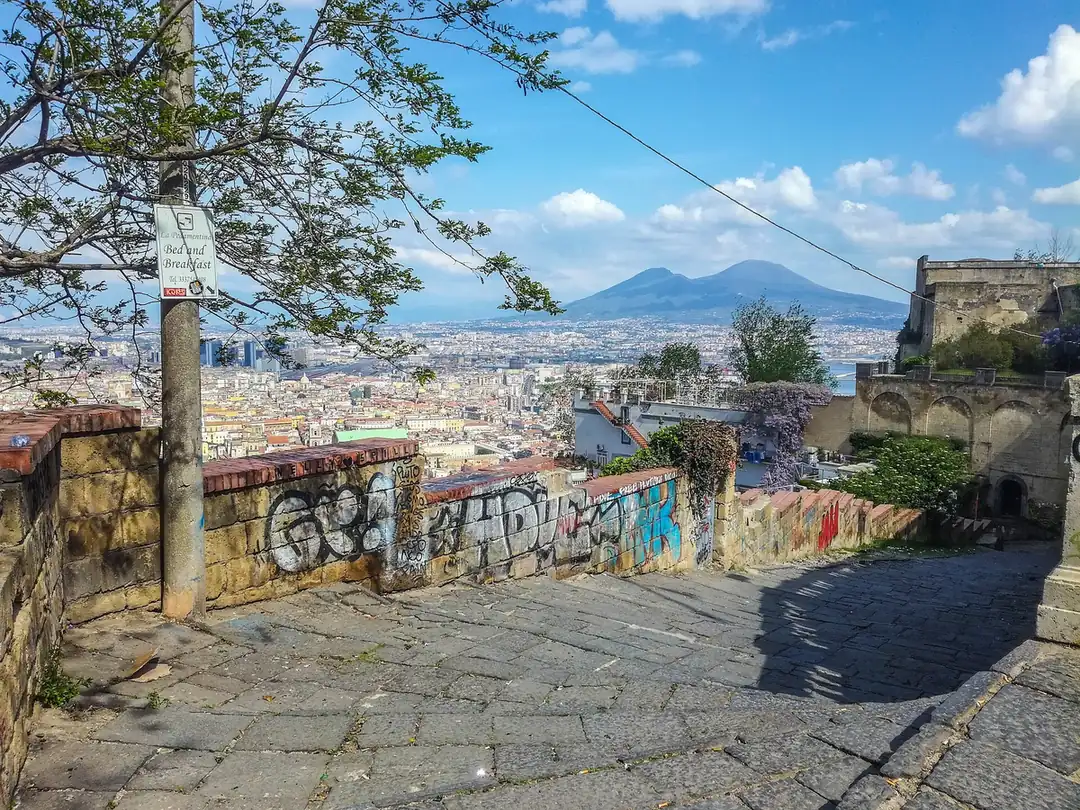
Then go out to the Terrazza Belvedere and the gardens, whose terraces look over the old town and the bay. The view is lower and closer than the one from the ramparts of Castel Sant'Elmo above: you look down into the roofs of the Centro Storico rather than across the whole gulf. Remember the gardens close an hour before the museum, so go there first on a late visit.
The presepe section and the Cuciniello nativity
The Ministry describes San Martino as Italy's most important public collection of the Neapolitan presepe, the nativity-scene craft that peaked in the 18th and 19th centuries. The section sits in the monastery's old kitchens. Its centerpiece is the Cuciniello presepe, a large scene of shepherds, market stalls, travelers and angels set in an artificial grotto, with lighting that cycles from dawn through full day and sunset to night.
If you walked up Via San Gregorio Armeno and wondered what the tradition looked like before the celebrity figures, this is the answer. It is also where the terracotta model for the Veiled Christ by Antonio Corradini is kept, the sketch Sanmartino set aside when he carved the statue in the Cappella Sansevero. Coming at Christmas? Pair it with our Christmas in Naples page.
Royal barges, a lost theater and the 19th century
- The naval section. Three royal barges, including a gilded 24-oar lancia given by the city of Naples to Charles of Bourbon, built in the Naples arsenal in the 1730s, and the white 14-oar barge of Umberto I of Savoy from 1889.
- The theater section. A wooden reconstruction of the stage of the San Carlino, the small popular theater below street level where much of Neapolitan comedy was born, with portraits, posters and masks.
- Ottocento a Napoli. A new permanent section of 12 rooms and about 200 works, opened on December 22, 2025: Capodimonte porcelain, landscape painting from the School of Posillipo, and the realists.
- The Prior's quarters and loggia, with paintings and views over the gardens.
Planning the visit
From Morghen, the upper station of the Montesanto and Chiaia funiculars, it is about 720 m to Largo San Martino, 10 minutes on foot. Castel Sant'Elmo is 200 m uphill; the two tickets are separate (€6 and €5), and we found no combined ticket in the Ministry's 2026 listings. Remember that the Certosa is closed all day on Tuesday, while the castle ramparts stay open.
Our Vomero and Pedamentina walk combines the funicular, both sites and the descent on foot. For the neighborhood itself, see the Vomero guide.
Frequently asked questions
How much does the Certosa di San Martino cost?
€6 for a full ticket and €2 for visitors aged 18 to 25 in 2026. Under-18s are free, and entry is free for everyone on the first Sunday of the month.
What day is the Certosa di San Martino closed?
Tuesday. On other days it is open 8:30 a.m. to 6:30 p.m., last entry 5:30 p.m. The museum sections open at 9:30 a.m. and the gardens close an hour early.
What is the Cuciniello presepe?
The centerpiece of the museum's nativity section: a large 18th and 19th-century Neapolitan presepe set in an artificial grotto, with lighting that simulates dawn, day, sunset and night.
Is there a combined ticket for Castel Sant'Elmo and San Martino?
We found none in the Ministry of Culture's 2026 listings. Tickets are separate: €6 for the Certosa and €5 for the castle, 200 m apart.
How do you get to the Certosa di San Martino?
Take the Montesanto or Chiaia funicular to Morghen and walk about 720 m, roughly 10 minutes. The address is Largo San Martino 5.
Further reading
Official sources
- Ministero della Cultura - Certosa e Museo di San Martino (official listing) – €6/€2, free under 18; closed Tuesday, 8:30 a.m.-6:30 p.m., last entry 5:30 p.m.; sections from 9:30; gardens close an hour early; Gothic undergrounds excluded until further notice; groups up to 25 without booking; no animals; Chiostro Grande and Dosio 1581; presepe section and Cuciniello lighting; naval section barges; San Carlino; page updated September 30, 2026; checked September 30, 2026
- Direzione regionale Musei Campania - Natale ai Musei del Vomero: 12 sale per l'800 napoletano (December 17, 2025) – New Ottocento a Napoli section, 12 rooms, about 200 works, opened December 22, 2025
- Wikipedia (Italian) - Certosa di San Martino – Founded 1325 by Charles of Calabria, consecrated 1368; Fanzago 1623-1656 and the 1656 dispute; Lanfranco vault 1636-39; Ribera's Moses and Elijah; Stanzione Pietà 1638; eight side chapels
- Museo Cappella Sansevero - The Veiled Christ (official) – Corradini's terracotta model of the Veiled Christ preserved in the Museo di San Martino
- Ministero della Cultura - Domenica al museo – First-Sunday free entry at state museums
- OpenStreetMap foot routing (routing.openstreetmap.de) – Morghen station to the Certosa about 720 m; Certosa to Castel Sant'Elmo about 210 m; computed September 30, 2026